

Making remote employees feel connected starts with giving them the same access to information, relationships, recognition, and opportunities as everyone else. That means communicating clearly, sharing context openly, creating regular opportunities to build relationships, recognising good work, and making sure remote employees can contribute and grow. The goal isn’t more meetings or virtual social events. It’s making distance irrelevant to whether someone feels part of the team.
Since starting Work for Impact in 2019, we've worked with remote professionals across the world. One thing I've noticed is that distance itself isn't usually the problem. People can work thousands of miles apart and still feel like they're part of the same team. We've seen outsourced teams become some of the most trusted, long-standing parts of an organization when they're given the same context, relationships, and ownership as everyone else.
The problems start when remote employees feel like they're on the outside looking in. And over time, that distance can affect more than morale. It can shape how people communicate, contribute, and ultimately whether they want to stay. That’s why connection deserves more attention in remote teams.
TL;DR: Making remote employees feel connected comes down to inclusion, not proximity. Give people the context they need, create regular opportunities to build relationships, include them in decisions, give them real ownership, recognize their work, and make development opportunities available wherever they're based. Track engagement, belonging, eNPS, and retention over time to spot signs of disconnection early. The strongest remote teams don't try to recreate the office—they make location matter less.
Why You Should Make Remote Employees Feel Connected To Your Team
Making remote employees feel connected isn't just about culture or morale. It can influence how people perform, collaborate, and whether they stay.
Gallup's research found a clear relationship between employee engagement and business performance. Compared with the least engaged teams, highly engaged teams achieve:
- 23% higher profitability
- 18% higher sales productivity
- 14% higher productivity based on production records and evaluations
- 10% higher customer loyalty and engagement
- 78% lower absenteeism
- 21% lower turnover in high-turnover organizations
- 51% lower turnover in low-turnover organizations
- 63% fewer safety incidents
- 32% fewer quality defects
Those numbers aren't specific to remote teams, but I think the lesson is particularly relevant when people don't share an office. A lot of what creates connection at work happens almost without thinking when people are in the same place: the quick conversation after a meeting, asking someone for their opinion, hearing what another team is working on, or getting recognition for something you've done well.
Remote teams don't have as many of those moments by default. You have to create the conditions for them.
That doesn't mean trying to recreate the office online. More meetings and virtual social events aren't necessarily going to make someone feel more connected. In my experience, connection comes from something more fundamental: being informed, being included, having strong working relationships, and knowing that your contribution matters.
When remote employees have the same access to those things as everyone else, location becomes much less important.
How To Make Remote Employees Feel Connected
Making remote employees feel connected comes down to inclusion. Give people context from the beginning, create opportunities to build real relationships, include them in decisions, recognize their contribution, and make sure location doesn't limit their opportunities.
Make Belonging and Context Part of Onboarding
I've found that connection starts with context. A new remote employee doesn't have the benefit of sitting alongside colleagues and gradually picking up how the business works, so you need to be more deliberate about giving them that understanding from the start.
Go beyond the job description. Explain what the company is trying to achieve, how their role contributes, how decisions get made, and who they'll be working with. Introduce them properly to those people rather than simply adding them to Slack and moving on.
During onboarding, make sure every remote employee has:
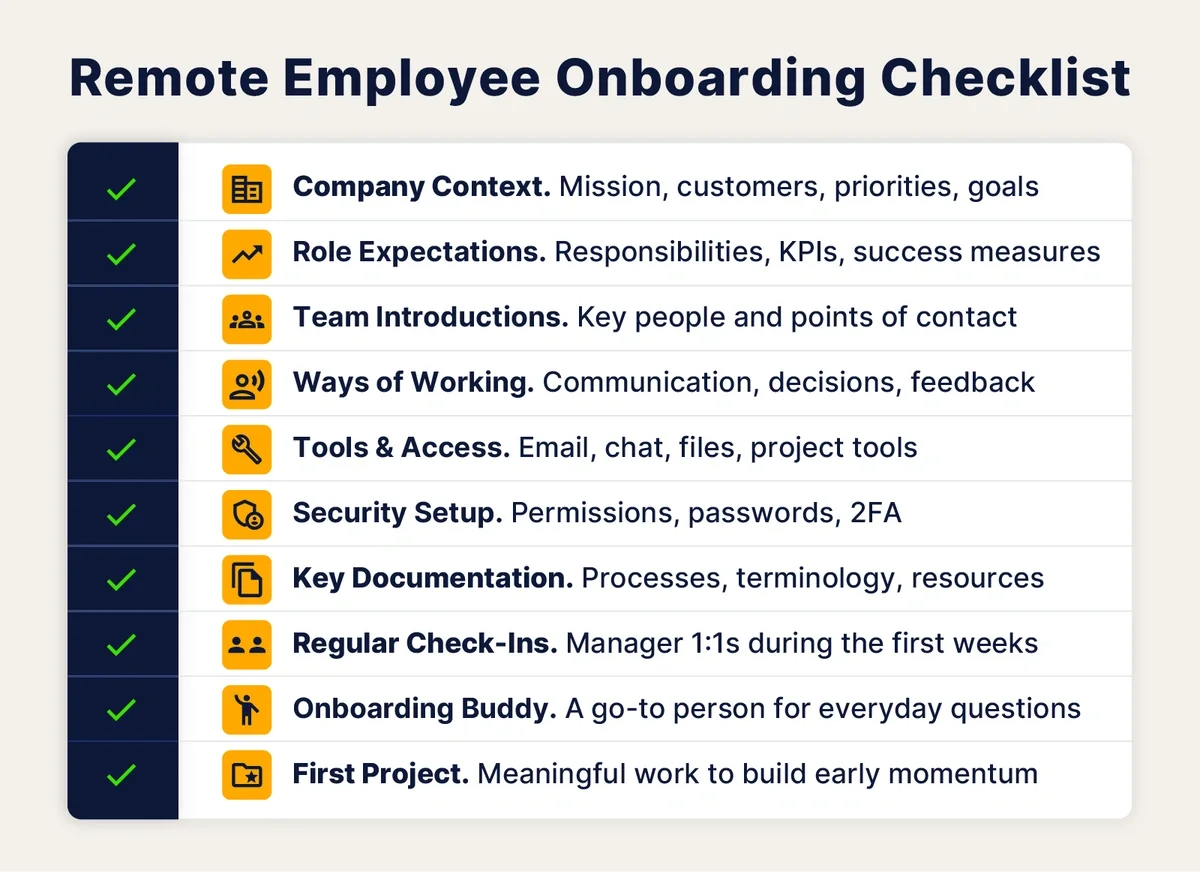
When people understand the business around their work, they can contribute sooner and make better decisions. More importantly, they start to feel like part of the team rather than someone working on the outside.
Create Space for Regular, Informal Communication
One thing that's easy to lose with remote work is the informal conversation that happens naturally in an office. You don't need to replace that with forced virtual social events, but you do need to create some space for people to get to know each other beyond the work.
That can be as simple as leaving a few minutes for conversation before a meeting, creating an informal Slack channel, or making sure 1:1s aren't entirely about tasks and deadlines. Managers should also check in regularly, because the small signs that someone is frustrated or disengaged are much easier to miss remotely.
|
Cadence |
Type |
|
Weekly or fortnightly |
One-on-one |
|
Monthly |
Goal review |
|
Quarterly |
Performance conversation |
The aim isn't more communication for the sake of it. It's to create enough regular contact that people build relationships and feel comfortable speaking up when something isn't working.
Give Remote Employees a Voice, Not Just Tasks
People feel more connected when they're able to contribute to how the work gets done, not just execute decisions made somewhere else.
This is particularly important with distributed teams.
If your remote employees only hear about projects once the decisions have been made, they'll naturally feel further removed from the business. Bring them into relevant discussions earlier. Ask for their perspective. Give them ownership over problems, not just a list of tasks.
I've found that people make better decisions when they understand the thinking behind the work.
You also get something valuable in return. Global teams bring different experiences and perspectives into a business. There's little point hiring great people around the world if you never ask what they think.
Give Remote Employees Authority, Not Just Tasks
People feel more connected when they have real ownership over their work. That means giving them the authority to make decisions within their role, rather than waiting for management approval at every step.
I've found this particularly important in distributed teams. Be clear about the outcome, the boundaries, and which decisions someone can make independently. Then trust them to get there. Context matters here too: the better people understand the business and why something matters, the better decisions they can make.
If you hire capable people but keep all the decision-making with management, you're only getting part of their value.
We've seen this with outsourced teams too. Outside Inc. built a global customer support team through Work for Impact that now supports more than 25 brands. As the team built knowledge and trust, they took ownership of increasingly complex work that had previously sat with the internal team.
Results: 25% cost savings and a 92% improvement in ticket resolution time.
Make Career Development Available Regardless of Location
One of the clearest tests of whether remote employees are genuinely part of the team is what happens when opportunities come up. Career development should be based on contribution and potential, not proximity to leadership.
At Work for Impact, for example, we use regular evaluation periods to step back and look at performance, development, and where someone can take on more responsibility. A six-month review is a good opportunity to discuss what’s working, where someone wants to grow, and what the next step could look like.
That might mean taking ownership of a bigger project, developing a new skill, or moving into a broader role. The important thing is that remote employees can see a path forward, wherever they happen to be based.
How to Tell Whether Remote Employees Feel Connected
Connection isn't an easy KPI to track. There isn't one number that tells you whether someone genuinely feels part of the team, and I wouldn't use things like Slack activity, meeting attendance, or time online as a proxy.
In many cases, it shows up as a lagging indicator. By the time engagement falls or someone leaves, they may have felt disconnected for months. That's why I'd track a combination of leading signals and longer-term outcomes:
|
KPI |
How to measure |
|
Employee engagement |
Average score from recurring engagement or pulse surveys. |
|
Employee Net Promoter Score (eNPS) |
% promoters minus % detractors from your employee recommendation question. |
|
Retention Rate |
Compare voluntary turnover between remote, hybrid, and office-based employees. |
|
Belonging score |
% of employees who agree with statements such as “I feel like I belong at this company.” |
The value isn't in any one metric. It's in watching how they move together over time and comparing the experience of remote employees with the rest of the team.
If engagement or belonging starts to fall, don't just treat it as an HR score to improve. Look at what's happening underneath it. Are people getting enough time with their manager? Are they being recognized? Do they have a voice in decisions? The numbers should tell you where to start asking better questions.
Remote Work Works Better When Everyone Feels Included
Building a connected remote team doesn't require more meetings or finding ways to recreate the office online. It comes down to giving people the same context, trust, recognition, and opportunities wherever they're based.
I've seen that when companies get those fundamentals right, location becomes much less important. People understand what they're working toward, feel comfortable contributing, and have the opportunity to grow with the business.
Profit Reimagined is a good example. Its global finance team spans three countries and has worked more than 5,000 hours through Work for Impact. Founder Christina Sjahli describes the people she's hired as part of the business rather than talent that feels outsourced.
If you're building a remote or distributed team, Work for Impact can help you find and manage global talent while taking care of the infrastructure behind it. Talk to one of our Talent Strategists to start building your global team.
Frequently Asked Questions
How do you make remote employees feel connected?
Give remote employees the same access to context, relationships, recognition, and development opportunities as everyone else. Good onboarding, regular manager check-ins, informal communication, clear ownership, and inclusion in relevant decisions all help. The goal isn't constant interaction. It's making sure people feel informed, trusted, and part of the wider team.
How do you keep remote employees engaged?
Start with clear expectations and meaningful work, then give people enough context and authority to take ownership. Regular feedback, recognition, career development, and strong relationships with managers also matter. Engagement tends to suffer when remote employees feel they're simply receiving tasks rather than contributing to the business.
How can managers build a sense of belonging in remote teams?
Belonging starts with inclusion. Introduce people properly during onboarding, create opportunities for informal conversation, recognize their work, ask for their input, and make sure they have access to the same opportunities as office-based colleagues. Managers should also use regular 1:1s to understand how people are doing beyond their immediate workload.
How often should managers check in with remote employees?
There's no perfect cadence, but I generally recommend weekly or fortnightly 1:1s, supported by monthly goal reviews and more structured quarterly performance conversations. The frequency matters less than consistency. Employees should know they have a regular opportunity to discuss their work, raise problems, and talk about their development.
How do you measure whether remote employees feel connected?
There's no single KPI for connection. Look at a combination of employee engagement, eNPS, belonging scores, and retention, and track how those measures change over time. If you have remote, hybrid, and office-based employees, comparing the groups can also help identify differences in their experience.
How can you prevent remote employees from feeling isolated?
Don't try to solve isolation simply by adding more meetings. Make sure remote employees have regular contact with their manager and colleagues, opportunities for informal conversation, meaningful collaboration, and a voice in decisions that affect their work. Strong remote teams create opportunities for connection without making social interaction another obligation.